What is exposure in photography? An explanation simple enough for a child.
A few years ago, I was asked to conduct an open photography lesson for children 10 to 16 years of age in order to get the kids interested in this hobby. It took me a long time to come up with the way to explain the concept of exposure to them so that they’d understand and remember it easily. I’ve been using this explanation ever since to teach both children and adults.
Even though we are all adults already, let's dive into the days of school bells and recesses:
“Let's imagine that light is water!” I said at the beginning of the lesson.
“Imagine that it has weight and can flow like a stream. It's not hard, just use your imagination!”
“Now let's imagine that the camera sensor behind the lens is an empty bucket, closed tightly with a lid.”
“The shooting button on the camera opens this cover and water starts pouring into the bucket. And the longer the lid is open, the more water will pour in, right?”
“Yes,” my young students answered in unison.
“It's the same with light. It also pours into the lens hole and hits the camera matrix. And, the longer the shutter that protects the matrix is open, the more light will “pour in” on it. And the brighter the photo will become.”
Shutter speed = photo brightness (exposure)
This is the first thing exposure affects. The more light hits the matrix, the brighter the frame will be. That is why night photos have to be shot with a shutter speed of several seconds. Or sometimes even minutes. On a bright sunny day, the shutter speed can be 1/8000-1/500 second. The darker, the longer the exposure. In the evening, it can be 1/250-1/60 or lower. And it gets even lower at night.
Blurring and shutter speed
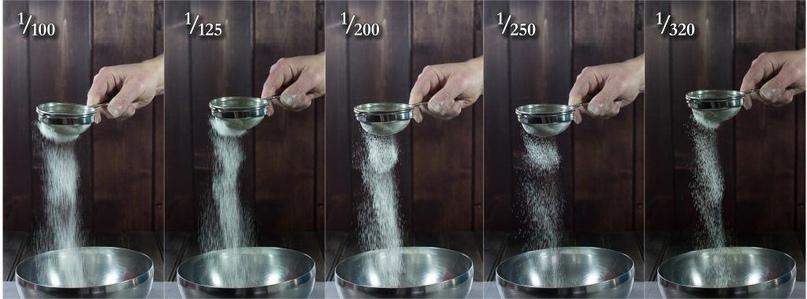
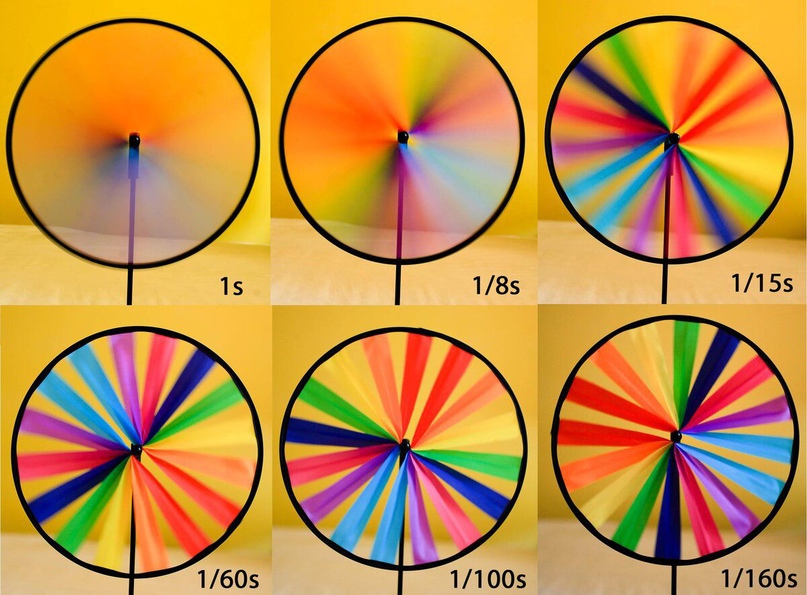
Shutter speed affects more than just the amount of light that hits the sensor. The slower the shutter speed, the blurrier will the moving objects be in the photo.
In the photo above, you can see how the flour pouring down is blurred (photo on the left 1/100 of a second), and how the flour granules sharpen up (photo on the right 1/320 of a second). Blur depends on shutter speed. Please pay attention: 1/100 of a second is a longer period of time than 1/320 of a second. This sends many beginners into a tailspin.
It is worth remembering these numbers to prevent blurry photos:
1/8000 sec. - 1/250 sec. - The photo is not blurry. Used outside, on sunny days, or in a very brightly lit room.
1/125 sec. - 1/60 sec. - The photo may be blurry. Used in interiors, in the evening time.
1/30 sec. - 30 sec. – An almost 100% guaranteed blurry photo. Use a tripod to take pictures. For rooms with very dim lighting and night time.
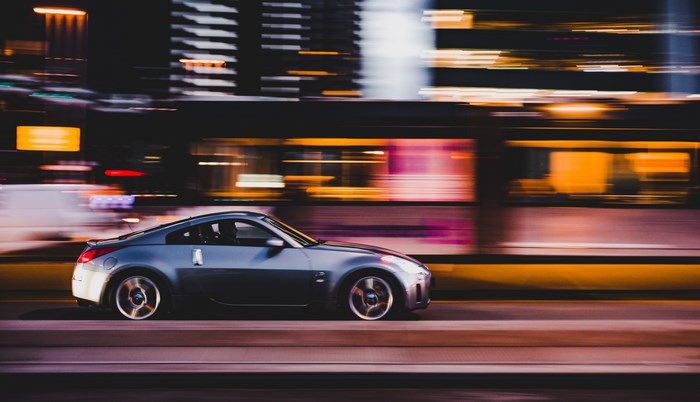
The photo below is a perfect visual representation of the relation between blurring and shutter speed
Conclusions:
There is nothing difficult in mastering the definitions and understanding the principles of photography. The main thing is attention and perseverance.
Of course, the kids whom I was teaching still had questions, and they weren’t afraid to ask them, so don't be afraid either, and feel free to ask! I’m always glad to answer!